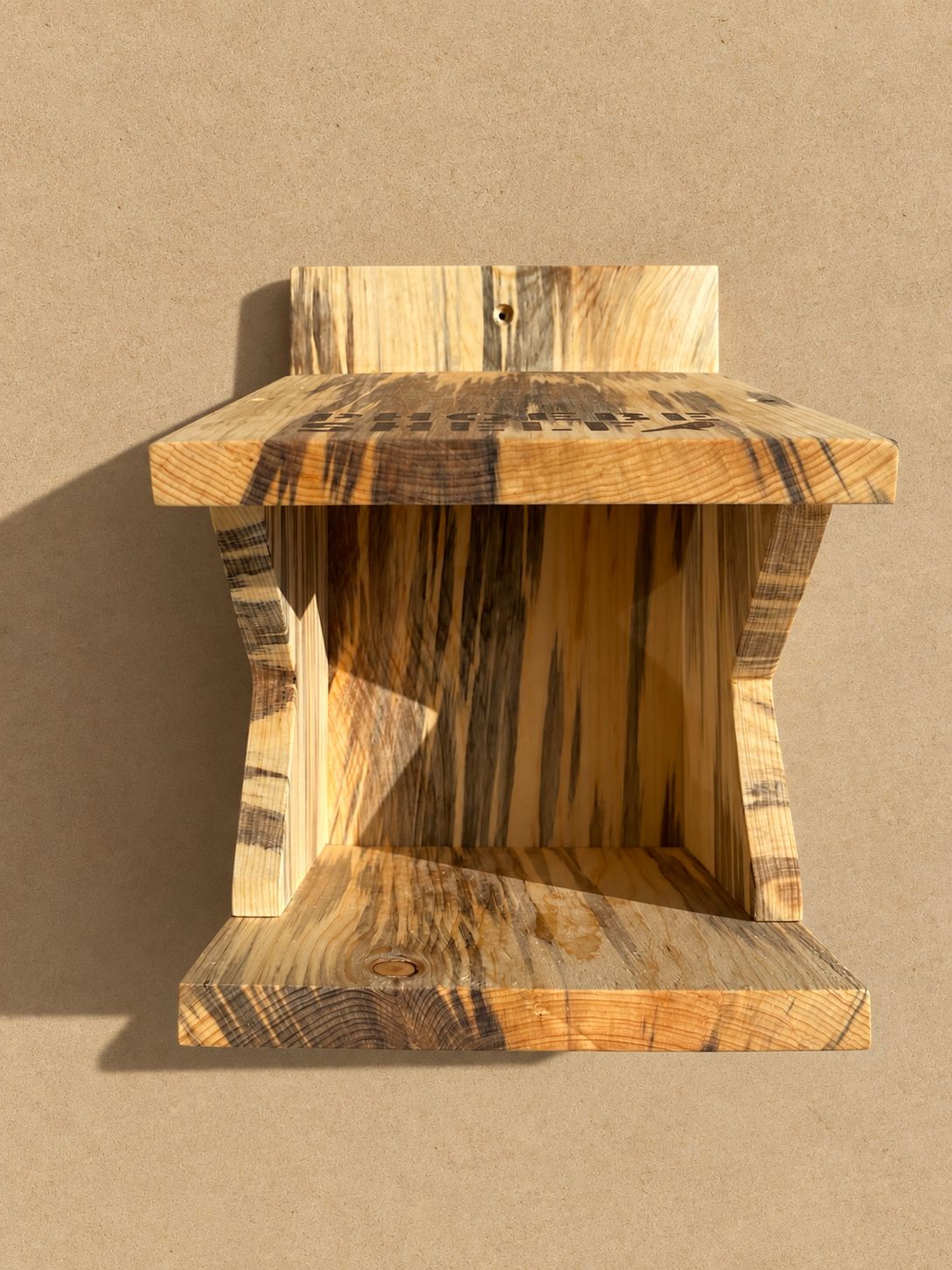
PRESALE - Phoebe Shelf
$55.99
Sold out
was $69.99 Save 20%
Sold out
Product Details
This is for PRESALE - Boxes will be shipped by October 2nd.
If more than one bird box is ordered, they may be shipped separately. Boxes may not arrive to destination on the same day.
Phoebe Shelf
Dimensions: 13.5”x8”x8.75”
An Open Ledge for Birds That Don't Want a Box
The Phoebe Shelf is designed specifically for Say's Phoebe, a species that doesn't nest in enclosed cavities the way most songbirds do. In the wild, phoebes build their nests on ledges, under eaves, on rock outcroppings, and against vertical walls - flat, sheltered surfaces with an overhang above and open air on every side. No amount of interior cavity space or entrance hole sizing matters to a bird that never intends to go inside a box in the first place. It needs a shelf, not a house. The same open-ledge design also suits American Robins, Barn Swallows, and Eastern Phoebes, all of which nest the same way and will readily take to the same shelf.
A Design Shaped Around the Bird, Not the Other Way Around
The Phoebe Shelf abandons the enclosed-box format entirely in favor of an open platform beneath an angled roof, mounted flush against a wall or vertical surface the same way a phoebe would choose a ledge under a porch overhang or rock face on its own. The roof is angled to shed rain and provide shade over the nest site, while the platform itself stays open on all sides, giving the bird full visibility and easy access in and out; exactly the setup it would seek out naturally, without a builder involved at all.
Who Is This For?
The Phoebe Shelf is the most flexible box in the lineup and works on nearly any property, since it mounts directly to a wall, eave, patio, or outbuilding rather than depending on surrounding habitat. It's a good fit for typical suburban lots, including smaller properties, and works especially well near covered porches, garages, barns, or other structures with a protected overhang. If you want a box that doesn't require acreage or established landscaping to succeed, this is it.
The Materials Behind Every Sonoran Standard Nest Box
Sourced From Standing-Dead Beetle-Kill Ponderosa Pine
Every Sonoran Standard nest box begins with ponderosa pine harvested exclusively from standing-dead trees killed by bark beetle infestations in the forests of northern Arizona. We do not use live-cut timber. These trees are rarely harvested at all; when a beetle-killed tree is removed from the forest, it is typically chipped, burned, or discarded, despite representing a significant wildfire hazard if left standing. We source ours specifically to put that wood to use instead.
The wood typically arrives from the mill at 20–25% moisture content, so drying is not something the standing-dead process does for us. Instead, it's a step we control ourselves. Beetle-killed pine does carry a distinctive blue-gray staining left by the fungus the beetles introduce, giving it a look that can't be replicated with conventional pine.
The timber is milled by a small, family-owned sawmill in northern Arizona that specializes specifically in standing-dead beetle-kill wood. From there, the boards are brought south to our own shop in Apache Junction, where we take over the remainder of the process ourselves. We dry the lumber in-house to the moisture content required for a product that will spend years exposed to direct desert sun and monsoon rainfall. Every box is cut, assembled, and finished by hand in our shop; nothing is outsourced, and nothing is mass-produced.
A Note on Natural Materials
Every Sonoran Standard nest box is built from real, standing-dead beetle-kill ponderosa pine - not a uniform manufactured material - so natural variation is part of the product, not a flaw in it. Color, grain pattern, and the extent of blue-gray fungal staining will differ from board to board and from box to box; no two pieces of this wood are identical, and each box will reflect the individual character of the tree it came from. Because the wood is a natural, breathing material, some minor swelling or movement may occur in response to humidity and temperature changes over time. This is a normal characteristic of solid wood construction and does not affect the durability or function of the box.
Hardware Built to Outlast the Elements
We use two distinct types of screws, each selected for a specific role. The screws used in assembling the box are corrosion-resistant, chosen to hold up over years of outdoor exposure without rusting or degrading. The screws used to mount the box - to a tree, post, wall, or structure - are marine-grade, built to withstand the same corrosive conditions over the long term. These mounting screws use a star-drive head rather than a standard slotted or Phillips design, so every box ships with the correct T25 bit included. No searching for the right driver and no compromise on holding strength.
Finishes Chosen for the Bird, Not Just the Buyer
Every finish on the box was selected with the animal that will live in it in mind. The exterior is treated with a bird-safe hardwax that shields the wood from ultraviolet light and rain without introducing anything harmful to a nesting bird. The interior is finished with food-grade mineral oil; this is the same standard used for cutting boards and butcher blocks, so there is nothing toxic anywhere near the nest cavity. Any painted surfaces use a bird-safe, low VOC, water-based paint, held to that same standard. Nothing about the finish process was chosen for convenience or cost; it was chosen because the bird occupying the box has no say in the matter, so we make the decision for it.
Biologically Accurate Design
Each box is built to the dimensions established for the species it is designed to house; entrance hole diameter, interior floor space, cavity depth, and mounting height all follow specifications drawn from established wildlife research. This level of precision matters, as a box built to approximate dimensions can fail to attract its intended species, or worse, can inadvertently make the cavity more accessible to predators or competing species than the design was ever meant to allow.
A Stain Made From What Would Otherwise Be Waste
Any text on the box itself - box labels and company name - is finished with a walnut husk stain we make ourselves, rather than a commercial wood stain, dye, or paint. Walnut husks are typically discarded once the nut inside is harvested, so we're putting a byproduct that would otherwise be thrown away to use instead of introducing another manufactured product into the mix. The stain is fully bird-safe, consistent with every other finish used on the box, so even the lettering is held to the same standard as the wood it's printed on.
Packaging With Minimal Plastic
The only plastic used anywhere in the product is the small bag holding the mounting screws and T25 bit. Every other component of the packaging - including the printed instructions - is paper. The instructions themselves are printed on carbon-neutral paper. This is a deliberate standard we hold ourselves to on every product, not an afterthought.
PRESALE - Phoebe Shelf